In early July, when Tehran is at its hottest and the rivers of the Alborz are running low, Iranians have an ancient excuse to throw water at one another. Tirgan, the midsummer festival, honours Tir, or Tishtrya, the spirit of rain and of the star Sirius, and remembers the legendary archer Arash, whose arrow fixed the borders of Iran. It is one of the four great seasonal festivals of ancient Iran, alongside Nowruz, Mehregan and Yalda.
Like Mehregan, Tirgan takes place on the day whose name matches the month, the day of Tir in the month of Tir. In the modern Iranian calendar it is usually celebrated on 13 Tir, which falls on 3, 4 or 5 July, while Zoroastrian communities keep the calendar-adjusted date of 10 Tir, around 1 July.
Two stories lie behind the festival. In Zoroastrian tradition, Tishtrya rides across the sky as a white horse to battle Apaosha, the black horse of drought, and after a long struggle wins the release of the rains. The second story comes from Iran’s epic past. After a long war between Iran and Turan, the two kings agreed that the border would be set wherever an arrow fired by an Iranian archer landed. Arash, the finest archer in the land, climbed Mount Damavand and fired with such force that he put his whole life into the shot. He died as the arrow left the bow, and according to the legend it flew from dawn until noon before landing on a walnut tree on the banks of the distant Oxus river, winning back a vast stretch of land for Iran.
How Tirgan is celebrated. The best-known custom is the water fight, or ab-pashi, when friends and family splash one another in memory of the rains. The other is the tir-o-bad, a wristband woven from threads of seven colours, like a rainbow, which is tied on at the start of the festival. Ten days later, on the day of Bad, the wind, people take it off and throw it into running water or let the wind carry it away, taking their wishes with it. Families share sweets, poetry and music, and traditional dishes include sholeh zard, the saffron rice pudding, and a spinach soup. In parts of northern Iran, Tirgan survived for centuries as a local harvest festival.
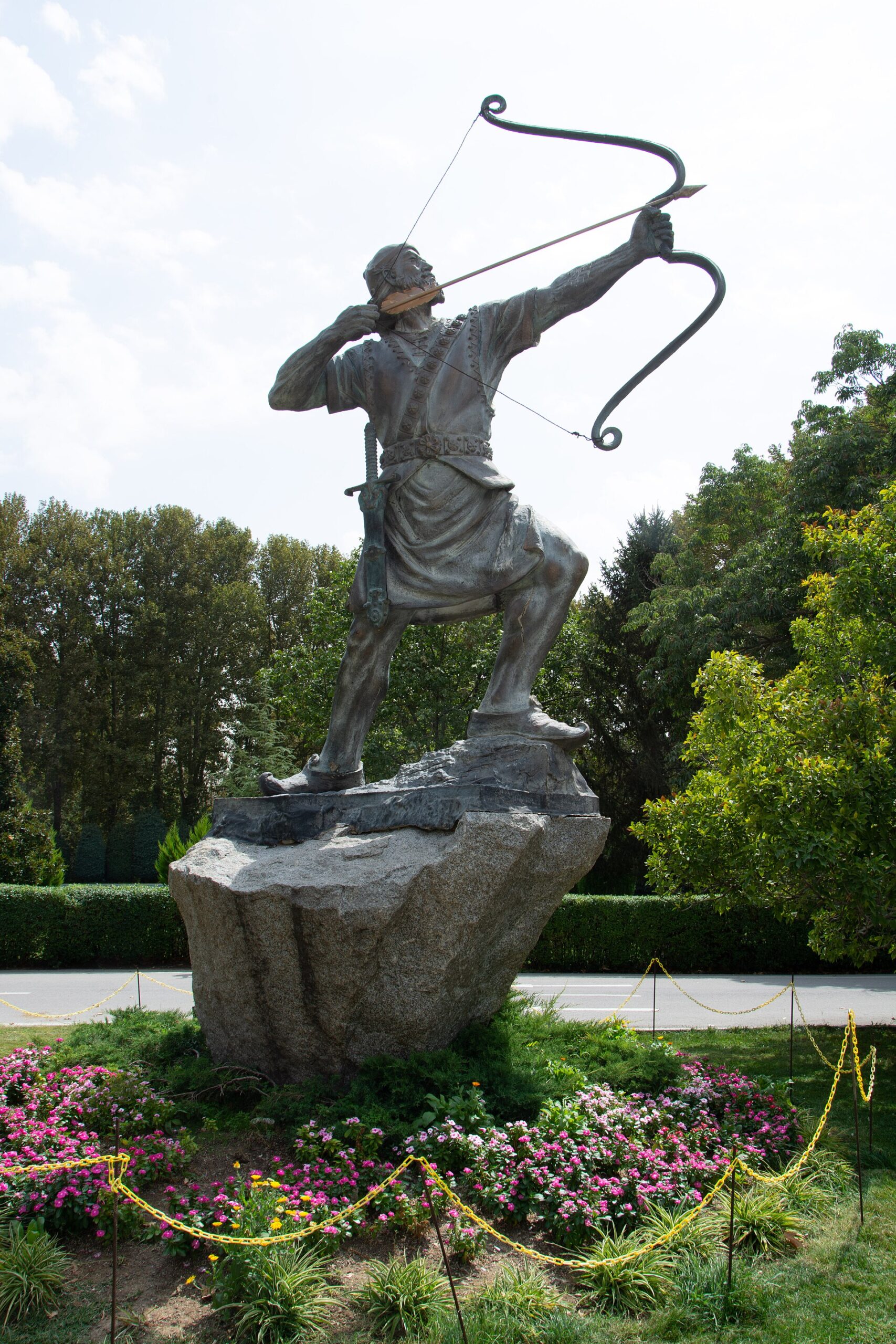
Tirgan in Tehran and beyond. In Tehran, Zoroastrian associations hold Tirgan gatherings, and many families celebrate quietly at home or on a picnic in the hills. Arash himself stands in bronze at the Saadabad Palace complex in the north of the city, a good place to start a summer walk. Outside Iran, Tirgan has become a major event for the diaspora, and the Tirgan Festival in Toronto is one of the largest Iranian cultural festivals in the world.
When is Tirgan? The next Tirgan falls on Sunday 4 July 2027 (13 Tir 1406). For the rest of the year’s ancient celebrations, see our guide to the ancient festivals of Iran.
Header image: Arash the Archer, whose arrow Tirgan remembers, at Saadabad Palace in Tehran. Photo: Ali Salaghi / Wikimedia Commons, CC BY-SA 4.0