Updated November 2026 The 2025–26 Pro League season was suspended because of the war and no champion was declared; the expanded 18-team 2026–27 season is now under way, with three Tehran clubs in the top flight.
Tehran’s top football teams are Persepolis and Esteghlal, two of the biggest clubs in Asia, whose rivalry dominates the city’s sporting life. A third Tehran-area side, Paykan, also plays in the Persian Gulf Pro League, Iran’s top division, while several smaller clubs compete lower down. If you live in the capital, even a passing interest in football will help you understand a surprising amount of everyday conversation.
The Persian Gulf Pro League
The Pro League has run in its current form since 2001 and from the 2026–27 season has 18 clubs, playing from late summer to spring. The previous season was suspended in early 2026 because of the conflict and was never completed, so no title was awarded and no clubs went down. Below it sits the Azadegan League, the second tier, where you will find several other Tehran clubs. The league’s official site, iranleague.ir, is in Persian; browser translation works well enough for fixtures and tables.
Persepolis
Persepolis, the Reds, founded in 1963, is Iran’s most successful and most widely supported club, with fans in every corner of the country. It has won 16 Iranian top-flight titles, nine of them in the Pro League era, including a long run of consecutive championships from 2017 onwards. Abroad, it won the Asian Cup Winners’ Cup in 1991 and reached the AFC Champions League final in 2018 and 2020.
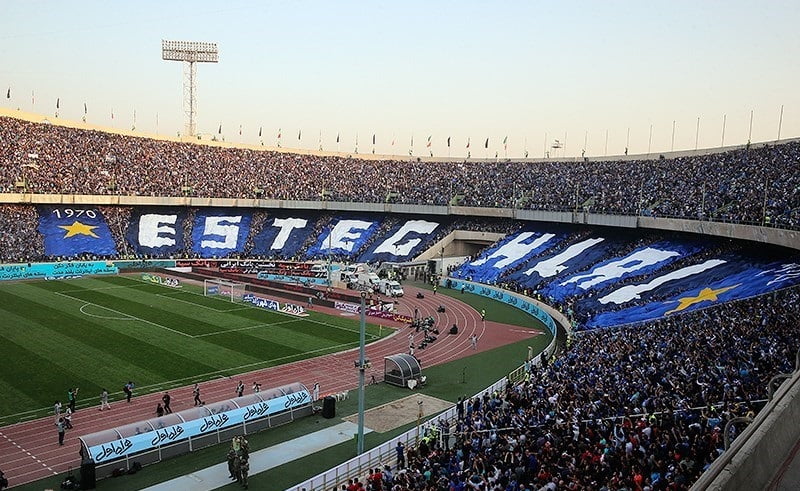
Persepolis plays its home games at Azadi Stadium, the huge bowl next to the Azadi Sport Complex in the west of the city. For a big match the atmosphere, all red flags and chanting, is worth experiencing at least once.
Esteghlal
Esteghlal, the Blues, is the older of the two giants. Founded in 1945, it was known as Taj until 1979, when it took its current name, which means “independence”. It has nine Iranian league titles, four of them in the Pro League era, and it was the first Iranian club to become champion of Asia, winning the Asian Club Championship in 1970 and again in 1991. It also shares Azadi Stadium as its home ground.
When play was suspended in February 2026, Esteghlal was top of the table, which earned it Iran’s place in the AFC Champions League Elite.
The Tehran derby
Persepolis against Esteghlal, known locally as the Sorkhabi derby (from the Persian words for red and blue), is one of the great city rivalries in world football. It is played at Azadi twice a season and has historically filled the stadium with tens of thousands of fans. The contest is famously tight, and a draw is a common result. On derby day the city’s traffic, cafés and offices revolve around the match, and you will know the score long before you check your phone.
Paykan
Paykan was founded in 1967 by the carmaker behind the Paykan, the car that was ubiquitous on Iranian roads for decades, and it remains linked to Iran Khodro, the country’s largest automaker. The club has moved around over the years, including a spell in Qazvin, but is now based in Shahr-e Qods on Tehran’s western edge, playing at the Shohadaye Shahr-e Qods stadium. It returned to the Pro League for the 2025–26 season. Its crowds are small, which makes a Paykan match a relaxed way to see top-flight football.
Other Tehran clubs
Tehran’s football scene once included more Pro League sides. Saipa, the team of Iran’s second-largest carmaker, and Naft Tehran, originally the oil company’s club, both played in the top flight for years. Neither is in the Pro League today, and Naft Tehran no longer exists in its old form. Other Tehran teams move between the Azadegan League and the lower divisions, and following them is a good way to see young players before the big clubs sign them.
Going to a match
Tickets are sold online through the ticketing system announced by the league and clubs before each match, and the process is in Persian. Registration usually requires an Iranian mobile number and national ID details, so ask an Iranian friend or colleague to help. Derby tickets sell out very quickly. Some matches have been played behind closed doors as a disciplinary or security measure, so check the latest news before you plan a trip to the stadium.
Arrive early, avoid wearing the colours of the away team if you are not sitting with their fans, and expect a long exit after the final whistle. Azadi Stadium has its own station on metro Line 5 (Varzeshgah-e Azadi), and on big match days the metro is far easier than driving. For English-language coverage, the sports pages of the Tehran Times and other Iranian English-language outlets report on every round.
If you would like to pick up enough Persian to follow the chants and match-day banter, the Persia Learning lessons are a good place to start.