Updated November 2026 We have corrected the palace’s construction and heritage dates, added its current role as the hospital’s medical museum and updated the directions.
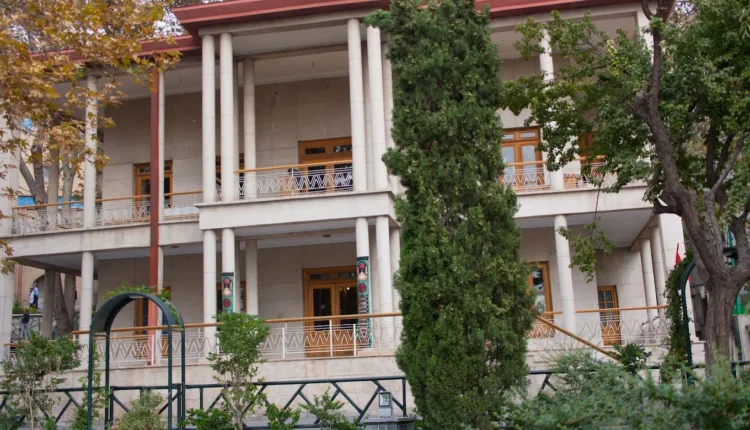
Mozaffari Palace, also called Darabad Palace or Shahabad, is a small Qajar-era palace in the Darabad neighbourhood of north-east Tehran, tucked inside the grounds of Masih Daneshvari Hospital. Built in the 1890s as a healthy retreat for the ailing Mozaffar al-Din Shah, it is one of the city’s least-known royal buildings and a rewarding detour if you are already exploring Niavaran. Allow about an hour, including the walk through the hospital grounds.

The palace’s story is bound up with tuberculosis. Mozaffar al-Din, son of Naser al-Din Shah and later king himself, contracted the disease as crown prince, and with no cure available his physicians recommended clean mountain air. The village of Darabad, on the slopes of the Alborz above Tehran, was chosen. According to a marble inscription inside the building, a large garden there was acquired in the solar year 1273 (around 1894), and the court minister Mohammad Khan Hakim al-Molk had a palace built in it. It was originally known as Shahabad.

The building’s link with medicine continued long after the shah’s death. The estate became a sanatorium for TB patients and, under Reza Shah, the core of a tuberculosis hospital. The physician Masih Daneshvari, who had trained in France, built it up into Iran’s leading centre for lung disease, and new wards and buildings were added around the old palace over the following decades. Today the hospital is a national research centre for tuberculosis and lung disease, and since around 2010 the palace has been set aside as its medical history museum.
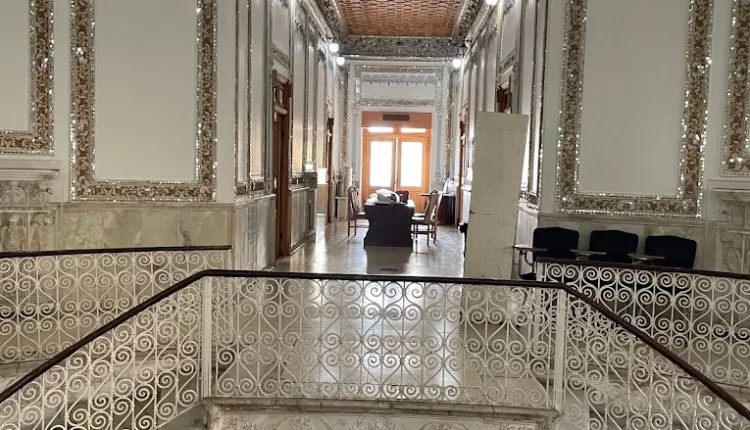
The palace itself is a compact two-storey building showing the European, and particularly French, influences that were fashionable at the Qajar court. Look out for the shallow elliptical ceilings, painted panels, delicate stucco and mirror work, the carved wooden ceilings and the marble fireplaces. In the courtyard, a fountain surrounded by star-shaped tiles is a pleasant spot to pause. It was registered as a national heritage monument (no. 3792) in September 2001.
Because the palace stands inside a working hospital, it does not keep the regular hours of a public museum. Visits are usually possible during the hospital’s daytime working hours, but access to the interior depends on the museum staff being present, so it is wise to have a Persian speaker phone the hospital in advance or ask at the main gate. Be discreet: you are walking through an active medical site, so keep noise down and do not photograph patients or wards.
The hospital sits at the northern end of Pourebtehaj Street, also known as Darabad Street. From Bahonar Square in Niavaran, head north up Pourebtehaj until the road ends at the hospital gates. The nearest metro station is Tajrish on Line 1; from there a taxi or ride-hailing car to the hospital takes around 15 to 20 minutes, depending on traffic. The Niavaran Palace complex is a short drive away if you want to make a morning of it, and our guide to Golestan Palace has more on the Qajar court. For other ideas in this part of the city, see our guide to hidden gems in Tehran.