Long before Iranians filled their homes with pomegranates for Yalda, they gathered in the first weeks of autumn for Mehregan, a harvest festival that was once second only to Nowruz in importance. Its name comes from Mehr, the ancient Iranian spirit (Mithra in older texts) who watched over friendship, love, promises and light. In modern Persian, mehr still means both kindness and the sun, and it gives its name to the seventh month of the Iranian calendar, the first month of autumn.
In the old Zoroastrian calendar, every day of the month had a name, and a festival was held whenever the name of the day matched the name of the month. Mehregan fell on the 16th of Mehr, the day of Mehr in the month of Mehr. Because the modern Iranian calendar gives the first six months 31 days rather than 30, the festival now falls on 10 Mehr, which is 2 October, and that is the date most Zoroastrian communities keep. Some people still mark the old date of 16 Mehr, 8 October.
The festival is also tied to one of the best-loved stories in Ferdowsi’s Shahnameh. The scholar Al-Biruni recorded that Mehregan was the day the hero Fereydun defeated Zahhak, the tyrant king with serpents growing from his shoulders, after the blacksmith Kaveh raised his leather apron as a banner and led the people in revolt. Fereydun chained Zahhak inside Mount Damavand, the great peak you can see from Tehran on a clear day, and the celebration became a festival of justice as well as of harvest.
Under the ancient Persian kings, Mehregan was a lavish state occasion, and it remained a major court festival for centuries after the arrival of Islam. Its public celebration faded after the Mongol invasions, and for a long time it survived mainly among Zoroastrians, especially in Yazd and Kerman. In recent years, interest has grown again among Iranians of all backgrounds, helped by social media and by cultural centres that hold talks, music and readings each autumn.
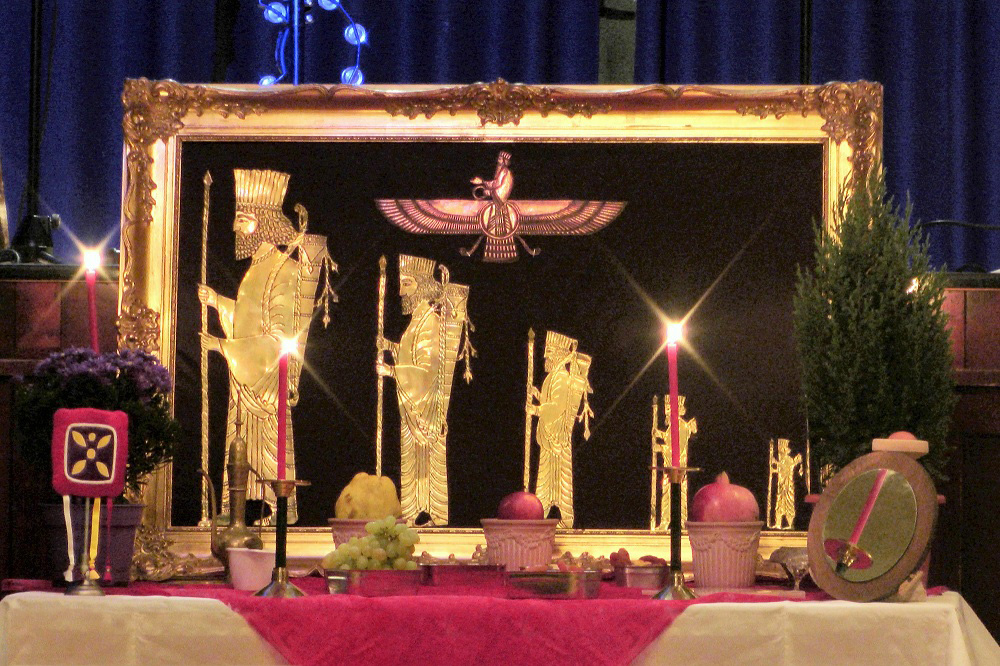
How Mehregan is celebrated. Families lay a festive cloth, or sofreh, much like the Nowruz table. It usually holds the fruits of autumn, such as pomegranates, apples, red grapes and persimmons, along with dried fruit, nuts, sweets, a mirror, candles, rosewater and a burner of esfand (wild rue) seeds, whose smoke is said to ward off the evil eye. A copy of the Shahnameh or the poems of Hafez often sits beside them. The day is for visiting friends and relatives, giving thanks for the harvest and mending broken friendships, in keeping with Mehr’s role as the guardian of promises.
Mehregan in Tehran. The festival is not a public holiday, and you will not see it on the streets the way you see Nowruz or Chaharshanbe Suri. Tehran’s Zoroastrian community marks it at its own centres, near the Adorian fire temple, and some cultural centres and private schools hold small celebrations. If you want to take part, ask Iranian friends or colleagues, many of whom now lay a Mehregan table at home. It is also a good excuse to make the most of Tehran in autumn, when the plane trees turn gold and the bazaars are piled high with pomegranates.
When is Mehregan? In 2027 Mehregan falls on Saturday 2 October (10 Mehr 1406), with the traditional date of 16 Mehr on Friday 8 October. For the rest of Iran’s seasonal festivals, from midwinter Sadeh to the summer water festival of Tirgan, see our guide to the ancient festivals of Iran.
Header image: A Mehregan table laid by Iranians in the Netherlands. Photo: PersianDutchNetwork / Wikimedia Commons, CC BY-SA 3.0