Tehran’s metro is the quickest way across a city where a 10-kilometre taxi ride can take an hour at rush hour. Seven lines and well over 150 stations now run from Tajrish in the foothills to Kahrizak in the south, out to Karaj and Hashtgerd in the west, and down to Imam Khomeini Airport and Parand. Trains are frequent, fares are cheap even after this year’s rise, and every station sign is in English as well as Persian. This guide puts everything in one place: the official map, the stations on every line, opening hours, fares, interchanges and the practical details that trip up first-timers.
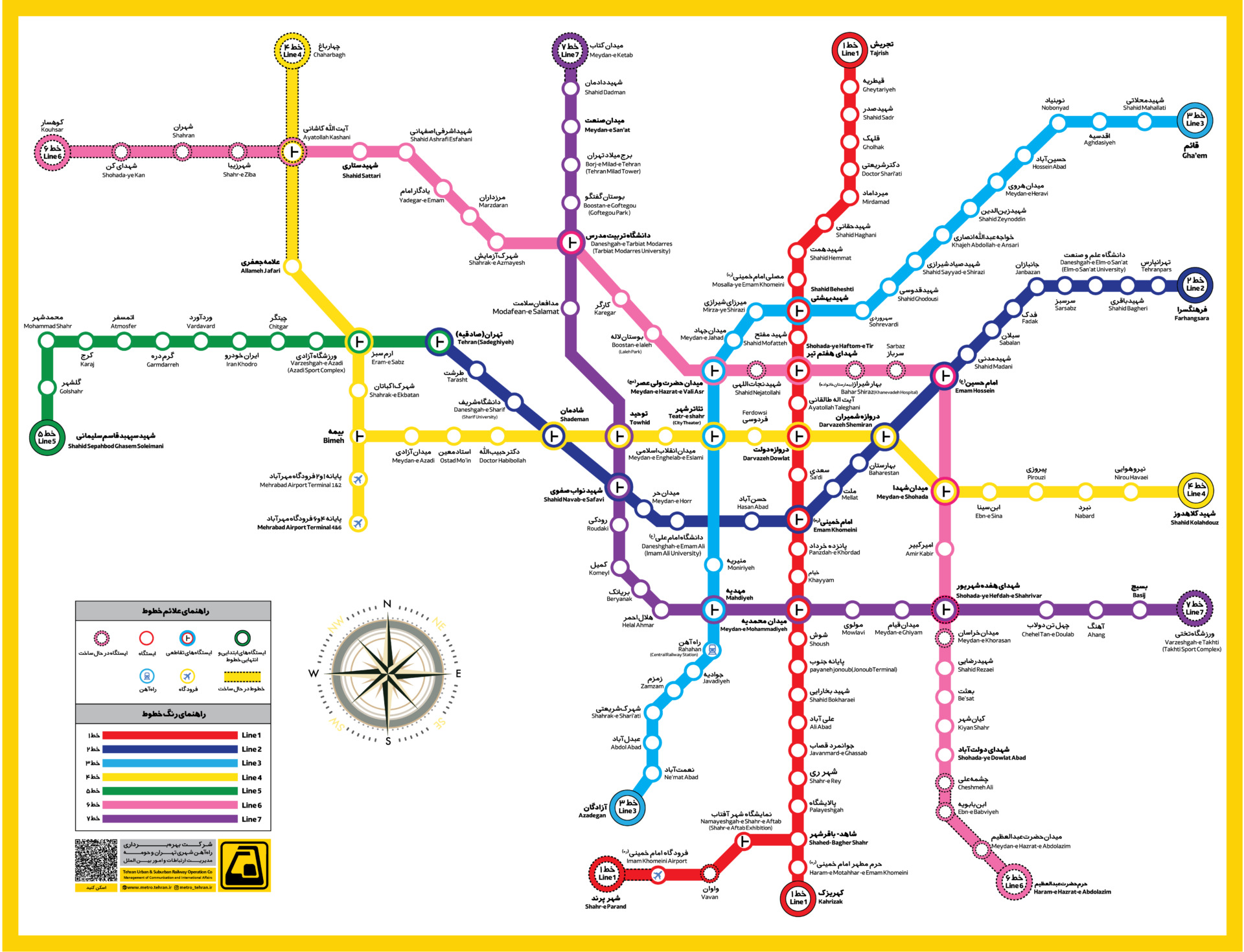
The lines at a glance. Each line has a number and a colour, and the colour is what most Tehranis use when giving directions. The table below gives the end stations and a rough end-to-end journey time. Times are approximate and longer at peak hours.
| Line | Colour | Route | Approx. end-to-end time |
|---|---|---|---|
| Line 1 | Red | Tajrish – Kahrizak (north–south), with a branch to Imam Khomeini Airport and Parand | 70 minutes |
| Line 2 | Dark blue | Tehran (Sadeghiyeh) – Farhangsara (west–east) | 45 minutes |
| Line 3 | Light blue | Gha’em – Azadegan (north-east–south-west) | 60 minutes |
| Line 4 | Yellow | Shahid Kolahdouz – Allameh Jafari (east–west), with a branch to Mehrabad Airport | 45 minutes |
| Line 5 | Green | Tehran (Sadeghiyeh) – Golshahr, Karaj (suburban), with a branch to Hashtgerd | 55 minutes |
| Line 6 | Pink | Shohada-ye Dowlat Abad – Kouhsar (south-east–north-west) | 50 minutes |
| Line 7 | Purple | Meydan-e Ketab – Varzeshgah-e Takhti (north-west–south-east) | 45 minutes |
Opening hours. Hours are tied to government office hours and change a few times a year, most recently in May 2026. At the time of writing, the city lines (1, 2, 3, 4, 6 and 7) start at about 5:30 in the morning, a little later on Thursdays and Fridays, and the last trains leave the end stations at 23:00. Line 5 to Karaj starts at 5:00 from Saturday to Wednesday, 5:30 on Thursday and 6:00 on Friday, with the last train at 22:00. The airport and Parand branch and the Hashtgerd branch run a much thinner daytime service, so check the timetable before relying on them. Around Nowruz, Ramadan and big religious holidays the metro often runs late into the night, and sometimes all night.
| Line | Saturday – Wednesday | Thursday | Friday | Last departure |
|---|---|---|---|---|
| City lines (1, 2, 3, 4, 6, 7) | c. 5:30 | later start | c. 6:00 | 23:00 |
| Line 5 (Tehran – Karaj) | 5:00 | 5:30 | 6:00 | 22:00 |
| Airport / Parand branch | Limited daytime service, trains roughly hourly or less | early evening | ||
| Hashtgerd branch | Limited daytime service | mid-afternoon | ||
Fares. New fares took effect on 21 April 2026 (1 Ordibehesht 1405), roughly 25 per cent higher than last year. Paying with a rechargeable metro card is much cheaper than buying single tickets. With a card you pay an entry charge of about 5,200 tomans, plus a small charge per kilometre after the first two kilometres, capped at 30 kilometres. The balance is deducted when you tap out, so always tap your card at the exit gate as well as the entrance. A new card costs 30,000 tomans to issue. Buying through the Shahrzad app gives an extra 10 per cent off.
| Single ticket | Paid by bank card | Paid in cash |
|---|---|---|
| City lines | 7,300 tomans | 10,000 tomans |
| Line 5 (Karaj) | 9,000 tomans | 15,000 tomans |
| Hashtgerd and Parand | 20,000 tomans | 25,000 tomans |
Line 1 (red). The oldest and busiest north–south line, running down Shariati Street and through the city centre to Rey and Kahrizak. It is the line most visitors use, linking Tajrish bazaar, the Imam Khomeini Square area near Golestan Palace and the bazaar (Panzdah-e Khordad), and the main southern bus terminal. Stations from north to south: Tajrish, Gheytariyeh, Shahid Sadr, Gholhak, Doctor Shari’ati, Mirdamad, Shahid Haghani, Shahid Hemmat, Mosalla-ye Emam Khomeini, Shahid Beheshti, Shahid Mofatteh, Shohada-ye Haftom-e Tir, Ayatollah Taleghani, Darvazeh Dowlat, Sa’di, Emam Khomeini, Panzdah-e Khordad, Khayyam, Meydan-e Mohammadiyeh, Shoush, Payaneh Jonoub (South Terminal), Shahid Bokharaei, Ali Abad, Javanmard-e Ghassab, Shahr-e Rey, Palayeshgah, Shahed–Bagher Shahr, Haram-e Motahhar-e Emam Khomeini and Kahrizak.

The airport and Parand branch. From Shahed–Bagher Shahr on Line 1, a separate branch runs south-west to Namayeshgah-e Shahr-e Aftab (the Shahr-e Aftab exhibition centre), Imam Khomeini International Airport and on to the new town of Parand. A further station at Vavan is under construction. Trains are infrequent, so many travellers with luggage still take a taxi, but the metro is by far the cheapest way to the airport if your timing works. You change at Shahed–Bagher Shahr. Our Imam Khomeini Airport guide covers the other options.

Line 2 (dark blue). Tehran’s first line, running west to east through the centre. It is useful for Sadeghiyeh, Sharif University, the old city around Imam Khomeini Square and Baharestan, and the eastern districts out to Tehranpars. Stations from west to east: Tehran (Sadeghiyeh), Tarasht, Daneshgah-e Sharif, Shademan, Shahid Navab-e Safavi, Meydan-e Horr, Daneshgah-e Emam Ali, Hasan Abad, Emam Khomeini, Mellat, Baharestan, Darvazeh Shemiran, Emam Hossein, Shahid Madani, Sabalan, Fadak, Janbazan, Sarsabz, Daneshgah-e Elm-o San’at, Shahid Bagheri, Tehranpars and Farhangsara.

Line 3 (light blue). A long diagonal line from Gha’em in the north-east, through the Seyed Khandan area and the city centre, to the central railway station and Azadegan in the south-west. It is the line for the railway station (Rahahan) and for Vali Asr Square and City Theatre. Stations from north-east to south-west: Gha’em, Shahid Mahallati, Aghdasiyeh, Nobonyad, Hossein Abad, Meydan-e Heravi, Shahid Zeynoddin, Khajeh Abdollah-e Ansari, Shahid Sayyad-e Shirazi, Shahid Ghodousi, Sohrevardi, Shahid Beheshti, Mirza-ye Shirazi, Meydan-e Jahad, Meydan-e Hazrat-e Vali Asr, Teatr-e Shahr, Moniriyeh, Mahdiyeh, Rahahan, Javadiyeh, Zamzam, Shahrak-e Shari’ati, Abdol Abad, Ne’mat Abad and Azadegan.
Line 4 (yellow). The main east–west line through the centre, passing Enghelab Square, the University of Tehran and Azadi Square. A short branch from Bimeh serves both terminals at Mehrabad Airport, the main airport for domestic flights. The line is being extended north-west from Allameh Jafari towards Chaharbagh. Stations from east to west: Shahid Kolahdouz, Nirou Havaei, Nabard, Pirouzi, Ebn-e Sina, Meydan-e Shohada, Darvazeh Shemiran, Darvazeh Dowlat, Ferdowsi, Teatr-e Shahr, Meydan-e Enghelab-e Eslami, Towhid, Shademan, Doctor Habibollah, Ostad Mo’in, Meydan-e Azadi, Bimeh, Shahrak-e Ekbatan, Eram-e Sabz and Allameh Jafari. The Mehrabad branch runs Bimeh, Mehrabad Airport Terminals 1 and 2, and Mehrabad Airport Terminals 4 and 6.
Line 5 (green). The suburban line to Karaj. It leaves Tehran (Sadeghiyeh), passes the Azadi Stadium and Chitgar, and runs west through Garmdarreh to Karaj and Golshahr. Trains are bigger and run at main-line speeds. From Golshahr a branch continues to Hashtgerd (Shahid Sepahbod Ghasem Soleimani station). Stations from Tehran: Tehran (Sadeghiyeh), Eram-e Sabz, Varzeshgah-e Azadi, Chitgar, Iran Khodro, Vardavard, Garmdarreh, Atmosfer, Karaj, Mohammad Shahr and Golshahr. Fares are higher than on the city lines.
Line 6 (pink). The newest north-west to south-east line, still being completed at both ends. It is handy for Tarbiat Modarres University, Laleh Park, Vali Asr Square and Haft-e Tir, and for the east and south-east of the city. Several stations along the route, including Nejatollahi, Bahar Shiraz, Sarbaz and Meydan-e Khorasan, are still being finished, and trains run through them without stopping. Stations currently in service include Kouhsar, Shahid Sattari, Shahid Ashrafi Esfahani, Yadegar-e Emam, Marzdaran, Shahrak-e Azmayesh, Daneshgah-e Tarbiat Modarres, Karegar, Boostan-e Laleh, Meydan-e Hazrat-e Vali Asr, Shohada-ye Haftom-e Tir, Emam Hossein, Meydan-e Shohada, Amir Kabir, Shohada-ye Hefdah-e Shahrivar, Shahid Rezaei, Be’sat, Kiyan Shahr and Shohada-ye Dowlat Abad. Trains run less often than on the older lines, roughly every 15 minutes.
Line 7 (purple). Another newer line, running from Meydan-e Ketab in the north-west past the Milad Tower, down through the west of the centre and across the south to Takhti Stadium in the east. It is the line for the Milad Tower and is useful for getting across the south of the city. Stations: Meydan-e Ketab, Shahid Dadman, Meydan-e San’at, Borj-e Milad-e Tehran, Boostan-e Goftegou, Daneshgah-e Tarbiat Modarres, Modafean-e Salamat, Towhid, Shahid Navab-e Safavi, Roudaki, Komeyl, Beryanak, Helal Ahmar, Mahdiyeh, Meydan-e Mohammadiyeh, Mowlavi, Meydan-e Ghiyam, Shohada-ye Hefdah-e Shahrivar, Chehel Tan-e Doulab, Ahang, Basij and Varzeshgah-e Takhti. Trains run about every 12 minutes.

Where to change. These are the interchange stations where two lines meet. Changing usually means a walk through connecting tunnels of a few minutes, longer at the big stations such as Emam Khomeini and Shohada-ye Haftom-e Tir.
| Interchange station | Lines |
|---|---|
| Shahid Beheshti | 1 and 3 |
| Shohada-ye Haftom-e Tir | 1 and 6 |
| Darvazeh Dowlat | 1 and 4 |
| Emam Khomeini | 1 and 2 |
| Meydan-e Mohammadiyeh | 1 and 7 |
| Shahed–Bagher Shahr | 1 and the airport/Parand branch |
| Tehran (Sadeghiyeh) | 2 and 5 |
| Shademan | 2 and 4 |
| Shahid Navab-e Safavi | 2 and 7 |
| Darvazeh Shemiran | 2 and 4 |
| Emam Hossein | 2 and 6 |
| Meydan-e Hazrat-e Vali Asr | 3 and 6 |
| Teatr-e Shahr | 3 and 4 |
| Mahdiyeh | 3 and 7 |
| Meydan-e Shohada | 4 and 6 |
| Towhid | 4 and 7 |
| Eram-e Sabz | 4 and 5 |
| Bimeh | 4 and the Mehrabad Airport branch |
| Daneshgah-e Tarbiat Modarres | 6 and 7 |
| Shohada-ye Hefdah-e Shahrivar | 6 and 7 |
Stations with other names. Many stations were renamed after the revolution or after the war, and Tehranis often still use the old names or the name of the nearest square. If someone gives you directions using a name that is not on the map, it may be one of these.
| Name on the map | Line | Also known as |
|---|---|---|
| Shohada-ye Haftom-e Tir | 1, 6 | Haft-e Tir Square |
| Emam Khomeini | 1, 2 | Toopkhaneh, or Park-e Shahr |
| Panzdah-e Khordad | 1 | Bazaar, or Galoubandak |
| Meydan-e Mohammadiyeh | 1, 7 | Meydan-e Edam |
| Shahid Bokharaei | 1 | Khazaneh |
| Haram-e Motahhar-e Emam Khomeini | 1 | Behesht-e Zahra |
| Meydan-e Jahad | 3 | Fatemi |
| Teatr-e Shahr | 3, 4 | Vali Asr crossroads (Chaharrah-e Vali Asr) |
| Shahid Sepahbod Ghasem Soleimani | 5 | Hashtgerd |
| Kouhsar | 6 | Shahid Arman Alivardi |
| Modafean-e Salamat | 7 | Sattarkhan, or Towhid Square |
Buying tickets. You cannot pay at the gate with cash or a bank card, so you need a ticket or a metro card before you go through. Single paper or QR tickets are sold at station ticket windows and machines, which accept Iranian bank cards. If you will use the metro more than a couple of times, buy a rechargeable metro card from a ticket window and top it up as you go. It is cheaper per journey and also works on the city buses and BRT. Foreign bank cards do not work in Iran, so visitors need cash in rials or an Iranian tourist card to top up (see our guide to money in Iran). Residents can also buy QR tickets in the city’s Shahrzad and Tehran-e Man apps and scan the code at the gate.
Women-only carriages. The first and last carriages of every train on the city lines are reserved for women and are marked in pink at the platform edge. Women can ride in any carriage, but men should stay out of the women-only cars. At peak times these are often the least crowded part of the train for women travelling alone.
Toilets. Only some stations have public toilets, and on Lines 1 and 2 they are usually just outside the station entrance, not on the platform. The stations below are the ones listed as having them.
| Line | Stations with public toilets |
|---|---|
| Line 1 | Tajrish, Gheytariyeh, Shahid Beheshti, Shohada-ye Haftom-e Tir, Emam Khomeini, Shoush, Shahid Bokharaei, Ali Abad, Javanmard-e Ghassab, Shahr-e Rey, Palayeshgah, Shahed–Bagher Shahr, Kahrizak, Imam Khomeini Airport (mostly outside the station) |
| Line 2 | Shahid Navab-e Safavi, Hasan Abad, Baharestan, Darvazeh Shemiran, Sabalan, Fadak, Daneshgah-e Elm-o San’at, Farhangsara (outside the station) |
| Line 3 | Nobonyad, Meydan-e Hazrat-e Vali Asr and Azadegan (inside); Shahid Sayyad-e Shirazi, Meydan-e Jahad, Teatr-e Shahr, Rahahan |
| Line 4 | Meydan-e Enghelab-e Eslami, Doctor Habibollah, Meydan-e Azadi |
| Line 5 | Chitgar, Iran Khodro, Vardavard, Garmdarreh, Atmosfer, Karaj, Mohammad Shahr, Golshahr (all inside) |
| Line 6 | Shohada-ye Dowlat Abad, Boostan-e Laleh |
| Line 7 | Meydan-e San’at, Roudaki, Beryanak, Basij |
Step-free access. Lifts are being added across the network, but step-free access is still patchy. Some stations have a lift from the street to only one platform, or only from the ticket hall down. Lines 1, 2 and 5 are the best equipped, and almost every Line 5 station is step-free. Lifts are sometimes out of service, so if you use a wheelchair or travel with a heavy pram, check at the ticket window before you go down.
| Line | Stations listed as wheelchair-accessible |
|---|---|
| Line 1 and airport branch | Gholhak, Doctor Shari’ati, Mirdamad, Shahid Beheshti, Shahid Mofatteh, Shohada-ye Haftom-e Tir, Sa’di, Emam Khomeini, Khayyam, Shoush, Payaneh Jonoub, Shahid Bokharaei, Ali Abad, Javanmard-e Ghassab, Shahr-e Rey, Palayeshgah, Shahed–Bagher Shahr, Haram-e Motahhar-e Emam Khomeini, Kahrizak, Imam Khomeini Airport |
| Line 2 | Tehran (Sadeghiyeh), Tarasht, Daneshgah-e Sharif, Shademan, Emam Khomeini, Emam Hossein, Shahid Madani, Janbazan, Sarsabz, Daneshgah-e Elm-o San’at, Shahid Bagheri, Tehranpars |
| Line 3 | Shahid Beheshti |
| Line 4 | Eram-e Sabz |
| Line 5 | Tehran (Sadeghiyeh), Eram-e Sabz, Varzeshgah-e Azadi, Chitgar, Iran Khodro, Vardavard, Garmdarreh, Atmosfer, Karaj, Mohammad Shahr, Golshahr |
| Line 6 | Kiyan Shahr, Amir Kabir, Emam Hossein, Shohada-ye Haftom-e Tir |
| Line 7 | Modafean-e Salamat, Basij |
Apps and journey planning. The official Tehran Metro app has the schematic map, a route planner, next-train times and a GPS “nearest station” finder, and its map works offline. Google Maps covers the metro in Tehran too and is handy for walking to and from stations. For buying tickets and topping up cards, use Shahrzad or Tehran-e Man. Both require an Iranian mobile number.
Getting the most out of it. Avoid the morning peak between about 7:00 and 9:00 and the evening rush from 16:00 to 19:00 if you can, especially on Lines 1 and 4 through the centre. Keep your phone and wallet in a front pocket in crowded trains, stand on the right on escalators, and let people off before you board. Hawkers selling everything from socks to phone chargers are part of the experience on many trains. For the rest of the city’s public transport, see our complete guide to getting around Tehran, our guide to the BRT bus system and our bus timetables and terminals guide.