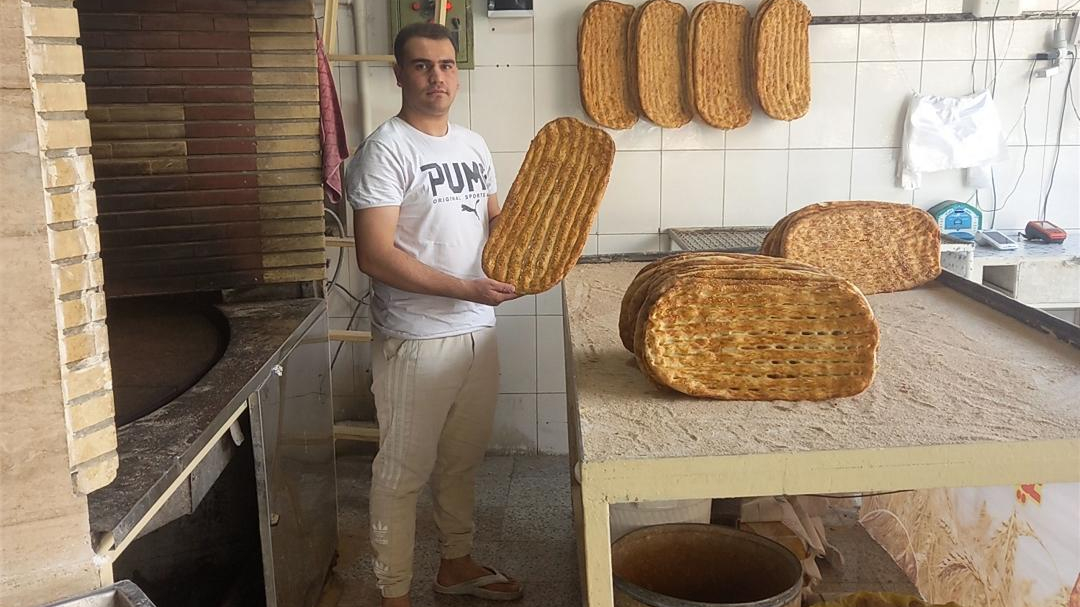
Barbari is Tehran’s breakfast loaf: thick, oval, and golden, with long grooves pressed down its length, a glossy finish, and a scattering of sesame, nigella, or poppy seeds. It is baked fresh through the morning, sold hot, and eaten while it is still warm — torn by hand, not sliced.
What barbari is
Look for an oval loaf that is thicker and softer than sangak or lavash, with a crisp, golden crust and a soft, chewy crumb. The grooves are not decoration alone: they help the loaf bake evenly and give it places to tear. Before baking, the dough is brushed with roomal, a flour-and-water glaze that gives barbari its shine and helps the seeds stick.
The topping varies by bakery. Some loaves are covered in sesame seeds; others use nigella seeds, poppy seeds, or a mix. If you have a preference, ask the bakery what today’s loaf is topped with — it is a normal question, and the answer changes from day to day.
Breakfast pairings
Barbari is made for the Iranian breakfast table. Eat it with:
- Feta-style white cheese and fresh herbs
- Butter and jam or honey
- Walnuts and cheese
- A fried egg, eaten straight from the pan or tucked into torn bread
- Tea, always tea — barbari and tea are a pair, not a coincidence
It also works later in the day for dipping into stews and for sandwiches, but its true home is breakfast, eaten hot, with simple accompaniments that let the bread itself be the point.
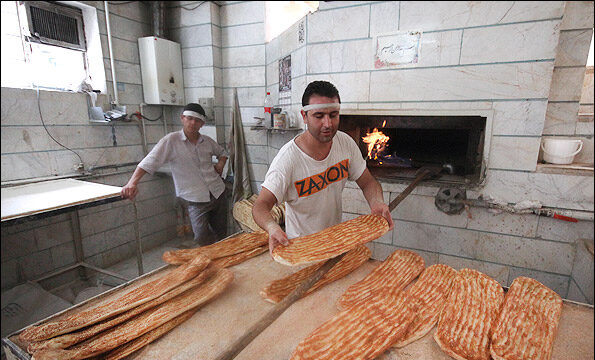
The bakery ritual
Part of barbari’s appeal is the ritual around it. Go in the morning, join the short queue, and watch the loaves come out of the oven in batches. The best time to buy is when a fresh batch is ready: the crust crackles, the bread steams when torn, and the seeds are at their most fragrant.
Take it home wrapped in paper, not sealed in plastic while it is still hot, or the crust will soften too quickly. If it cools before you eat it, a brief warming in a hot oven or on a dry pan brings back much of its character — but nothing quite matches the first ten minutes out of the oven.
What’s in the name? A sensitive history
The name barbari is traditionally linked to the Barbar — the name used in old Tehran for Hazara people who came from the east and, according to the traditional account, baked this bread in Tehran. That history should be told with care: it is a story about people who moved, worked, and became part of Tehran’s food life, not a label to use carelessly about any community today.
Under Reza Shah, the name was later changed to Khavari — meaning eastern — in an official renaming. This draft gives no year for that decree, because the decree year is unknown and should not be guessed. If you see a year attached to the Khavari renaming elsewhere, treat it as unverified until a reliable source confirms it.
Origin: late Qajar, not the 1930s
Barbari’s origin in Tehran is placed in the late Qajar period, in the 1890s — the solar years 1269 to 1279. It is explicitly not a 1930s invention in this account. Later decades may have changed how widely it was sold, how bakeries were organized, or how the name was used, but the bread’s Tehran origin belongs to the late Qajar era, not to the 1930s.
Competing origin stories circulate, and they should be labelled as stories, not settled fact. One story credits the Hazara bakers of Tehran; other stories emphasize different bakers, neighbourhoods, or routes by which the bread became a Tehran staple. This draft does not choose one story as proven history. What is clear is the bread’s place in Tehran today: it is the city’s signature breakfast loaf.
The Tabrizi variant
A variant known as Tabrizi barbari is also noted — a barbari associated with Tabriz. It is presented here as a variant name, not as a separate, fully distinct bread with its own settled recipe in this draft. If a Tabriz bakery sells barbari under that name, its size, thickness, or topping may differ from a Tehran loaf, and that local difference is worth noting rather than flattening into one standard.
For the wider world of Iranian breads, see the companion guide: barbari is one of four nationwide breads, alongside sangak, lavash, and taftoon.
Learn the Persian: Find the Persian for ingredients, dishes and cooking words in our free food and drink vocabulary, with flashcards to practise.