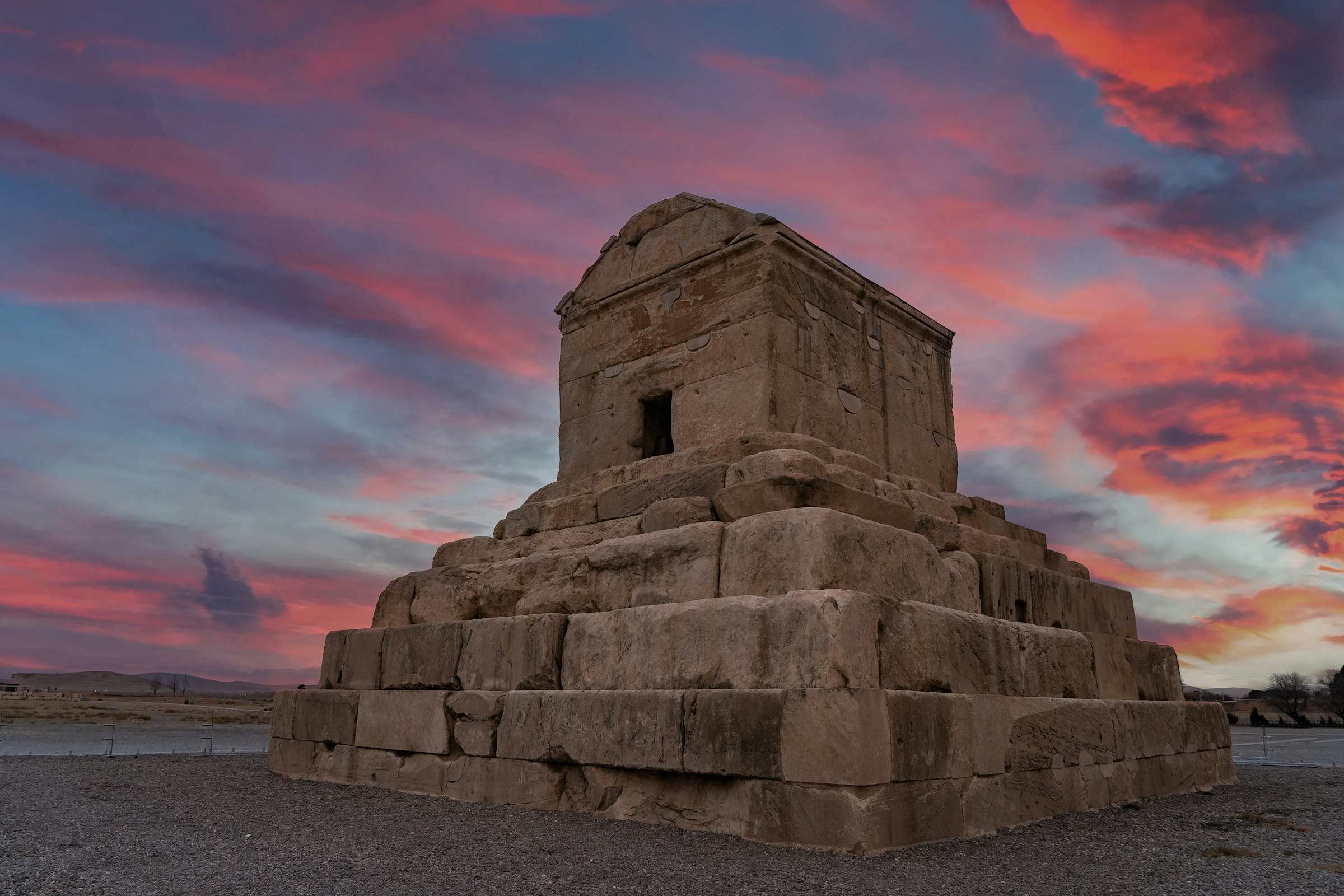
 Akbar Nemati, Unsplash
Cyrus the Great Day: Why Iranians Still Honour a King From 2,500 Years Ago
One autumn day, an ancient king, and a memory kept alive by people in Iran and around the world
Cyrus the Great Day falls on 7 Aban in the Iranian calendar, usually 29 October. It is an unofficial commemoration, not a public holiday, and it centres on Pasargadae in Fars province, where the Tomb of Cyrus the Great stands.
What the day is
Cyrus the Great Day is kept alive by ordinary people through remembrance: a shared photograph of the tomb, a post online, and the memory of a king who lived more than 2,500 years ago. The day is shaped less by ceremony than by memory, and by the feeling that a very old story still belongs to the present.

Iranians today: pride and belonging
For most Iranians, in Iran and around the world, Cyrus is a source of deep pride. He is remembered as the founder of the first Persian Empire, and as the figure at the start of a long Iranian story. That story did not stop with him. It continued through changing languages, faiths and rulers, and Cyrus remained part of it.
That is why he still feels close. He is not only a king in a history book. He is a shared symbol of Iranian identity, claimed by ordinary people across ethnic backgrounds and faiths. Persians, Kurds, Azeris, Baluch, Turkmen, Arabs, Jews, Christians, Zoroastrians and others all have a place in Iran’s long story, and Cyrus belongs to that wider story rather than to any one group alone.
He has also survived changing regimes while still being claimed by ordinary people. Governments have come and gone, and the way Cyrus is spoken about in public has changed, but the pride many Iranians feel for him has a life of its own. It is passed on in families, in names, in poetry and in posts shared on 29 October. For many, saying his name is a way of saying: this history is ours, and we are still part of it.
گرامی باد روز هفت آبان. زادروز بزرک مرد و پادشاه ایران زمین کوروش بزرگ.
— Jubin (@Jubin39383187) October 29, 2026

The empire he built
Cyrus, known in Persian as Kourosh, founded the Achaemenid Empire in the sixth century BCE. From a kingdom in southwestern Iran, he built an empire that stretched across a vast part of the ancient world. It was, for its time, the largest empire the ancient world had yet seen.
Look at a map and the scale becomes clear. In the west it reached Anatolia and the Levant, along the eastern Mediterranean. In the east it reached Central Asia and the Indus. Between those edges lay many peoples, languages and ways of life, brought together under one administration, with roads, officials and a shared system of rule. That breadth is part of why Cyrus still looms so large: he did not only win battles, he held a huge and varied world together.

The Jews: a return home
For many people outside Iran, Cyrus is famous for one act, and it is told as a story of homecoming. In 539 BCE, Babylon fell to Cyrus. For Jews who had been taken into exile in Babylon, that changed everything. Cyrus allowed them to return to Jerusalem, to rebuild the Temple, and to take back the temple vessels that had been carried away.
Imagine what that meant after years away: a road home, a city to rebuild, and sacred objects returned rather than kept as spoils. The story is not only about a king’s order. It is about people carrying their belongings back, rebuilding what had been lost, and beginning again.
That story also connects to a longer Jewish story in Iran. Jews have lived in Iran for a very long time, and their history there runs alongside the wider Iranian story, not apart from it. For a closer look at Jewish life in Iran today, see LiT’s Exploring Tehran’s Historic Jewish Quarter. In that long view, Cyrus stands at a turning point: a Persian king whose decision helped a displaced people return, and whose name has been remembered with gratitude ever since.

Even his rivals’ historians praised him
Perhaps the most striking praise for Cyrus comes from writers who had every reason not to give it. Herodotus and Xenophon were Greek writers, from a culture that fought Persia. Yet both wrote about Cyrus with admiration, and Xenophon made him the subject of a long work about leadership and rule.
Xenophon’s point was not only that Cyrus won wars. It was that people followed him willingly. In Xenophon’s view, Cyrus was treated less like a distant conqueror and more like a father to his subjects, and that was why his rule held. As Xenophon put it, in this view:
They obeyed him willingly, and looked to him as a father.
That is Xenophon’s view, not a neutral fact, and it matters because it comes from the other side. A Greek writer, writing for Greek readers, still presented a Persian king as a model of how to lead. Centuries later, that image has stayed with Cyrus: a ruler remembered not only for power, but for the loyalty he inspired.

The Cyrus Cylinder
One object has done more than most to shape how Cyrus is described around the world: the Cyrus Cylinder. It is a clay cylinder inscribed after the conquest of Babylon, and it is associated with allowing deported peoples to return home and to worship freely. A copy of it is displayed at the United Nations in New York.
Because of that, it is widely celebrated as an early symbol of tolerance and human rights. That celebration is real, and it is part of why the cylinder is so well known. At the same time, historians debate calling it a modern charter. It was written in its own time, in its own language of kingship, not as a document for the modern world. Its power is as a symbol that Iranians and others still claim: a small clay record that has come to stand for return, respect and a more humane way of ruling.

Pasargadae
Pasargadae is a UNESCO World Heritage site, set in a broad plain in Fars. The tomb is its most striking sight, and also its most restrained: a simple limestone chamber, raised on stepped tiers, with a small doorway and a pitched roof. There is no gold and no grand decoration. Its quietness is part of its power.
The day today: 29 October / 7 Aban
On 29 October, or 7 Aban, access roads to Pasargadae are usually closed for the day. The closure is in keeping with a long-running official emphasis on religious identity, rather than on public gatherings centred on Iran’s pre-Islamic past. The marking of the day is people-led, not government-sponsored. People-led events take place in Iran and outside Iran, and when people cannot gather at the tomb, they post instead. Photographs of the tomb, short videos and simple messages of remembrance circulated again on 29 October 2026, reaching Iranians inside the country and abroad.
HAPPY CYRUS THE GREAT DAY
— Rastakhiz (@sedaye_iran) October 29, 2026
Why the day still matters
Cyrus the Great Day is not about one party, one faith or one version of Iran. It is about a shared, inclusive heritage that still brings people together: a king remembered for return and respect, a tomb on a quiet plain, and a name passed from one generation to the next. Like Nowruz, the ancient Persian New Year, it is kept alive less by ceremony than by remembrance, and in this case by the posts that carry it each autumn.