Updated November 2026 Refreshed for the next Muharram season: Ashura is expected to fall in mid-June 2027, depending on the sighting of the moon.
Nazri is the Iranian tradition of cooking and giving away free food as a religious offering, and it reaches its peak around Ashura, when Tehran’s streets fill with pots of stew, rice and sweet saffron pudding handed out to anyone who passes. If you are in the city during Muharram, you will almost certainly be offered a plate, whoever you are and whatever you believe.
Ashura is the tenth day of Muharram, the first month of the Islamic lunar calendar. For Shia Muslims it marks the death of Imam Hussein, grandson of the Prophet Muhammad, and his companions at the Battle of Karbala in 680 AD, after a siege of several days. It is the most important period of mourning in the Shia year, and in Iran the ninth and tenth days, Tasua and Ashura, are public holidays. Because the lunar calendar moves about eleven days earlier each year against the Western calendar, Ashura shifts season over time; in 2027 it is expected in mid-June, with the exact day confirmed only once the new moon is sighted.
Food is central to the commemoration. A person makes a nazr, a vow or pledge, and fulfils it by preparing food and sharing it, often in thanks for a prayer answered or in memory of a loved one. Over the first ten days of Muharram, and especially on Tasua and Ashura, households, mosques and neighbourhood groups known as heyat set up stalls and kitchens across the capital. Expect to be handed tea, sharbat (sweet cold drinks) or juice from roadside kiosks, and to see queues forming at tables serving full meals.
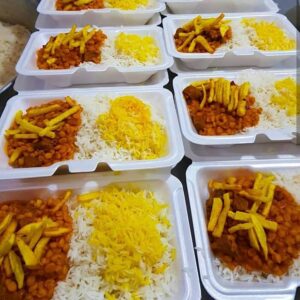
The classic nazri dishes are ones that can be cooked in huge quantities. Gheimeh, a stew of split peas and meat served over rice, is perhaps the most common; you will also come across sholeh zard, a saffron rice pudding decorated with cinnamon, as well as adasi (lentil soup), halim (a wheat and meat porridge often eaten at breakfast) and ash reshteh, a thick noodle and herb soup. Quality varies from street to street, and some neighbourhoods have a reputation for particularly good nazri.
The custom has grown well beyond the family kitchen. In recent years companies, employers and organisations have taken to sponsoring nazri on an almost industrial scale, while in the older streets and alleys of Tehran families still cook their own pots and carry dishes round to their immediate neighbours. Non-Muslim residents and foreigners are routinely included, and a knock at the door with a covered bowl is common. If you receive food, accept it with thanks; it is polite to return the bowl washed, and many people return it with something of their own inside rather than empty.
If you want to find nazri distribution points, an app called Nazriyab (available on the Cafe Bazaar Android store) maps registered stations around the city, and local news and neighbourhood groups also share locations. A few practical tips for visitors: dress modestly, as these are mourning ceremonies rather than festivals; expect heavy traffic, road closures and processions on Tasua and Ashura; and note that many restaurants and shops close on those two days. If you are not in need of a free meal, the kind thing to do is leave the queue to those who are and spend your money at a local restaurant once the holiday is over. For an idea of what eating out costs in the meantime, see our Iran price trackers.