Updated November 2026 Most Tehran museums have reopened since the April 2026 ceasefire, but Golestan Palace was damaged in March 2026 and parts of it have been closed for repairs, so check before you go.
Behind Tehran’s traffic and tower blocks, a handful of grand historic mansions survive, many of them now museums you can walk around for the price of a ticket. These are the top mansions to visit in Tehran if you want to see how the city’s Qajar and early Pahlavi elite lived, from mirror-covered royal halls to a merchant’s house full of clocks.
Many museums closed during the conflicts of 2025 and 2026 and reopened in stages; the Tehran Museum of Contemporary Art, for example, was back open by May 2026 (The Art Newspaper). Opening times change often, so confirm locally before making a special trip.
1. Golestan Palace
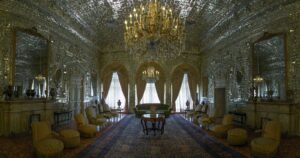
The former royal compound of the Qajar shahs, beside the Grand Bazaar, is a UNESCO World Heritage Site (listed in 2013) and the most famous historic complex in the city. Expect mirrored halls, painted and plastered ceilings, dazzling tilework and a formal garden of pools and evergreen trees. Do not miss Shams-ol Emareh, the tall “Edifice of the Sun”, and the Badgir (wind tower) mansion.
In March 2026 strike shockwaves broke many of the palace’s doors and windows and seriously damaged the Mirror Hall and the Marble Throne, and the complex was closed for emergency work (Al-Monitor). Ask which halls are open before you buy a ticket. Read more in our Golestan Palace guide.
2. Masoudieh Palace

Built in the late 19th century for the Qajar prince Zell-e Soltan, Masoudieh Palace sits near Baharestan Square in the old centre. Its courtyards, brickwork and halls mix Persian and European styles. It combines easily with a walk to Golestan Palace and the bazaar.
3. Glass and Ceramics Museum (Abgineh)
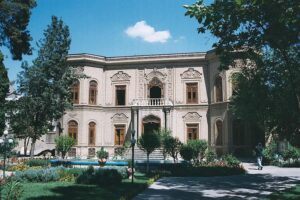
This elegant mansion on Si-e Tir Street was built for the statesman Ahmad Ghavam at the end of the Qajar era and later housed the Egyptian embassy before becoming a museum. The building blends Iranian and European design, with a carved wooden staircase in a Russian style, and the collection of Iranian glass and pottery spans thousands of years. Afterwards, eat your way along the 30 Tir food street outside.
4. Roshan building on Naser Khosrow Street
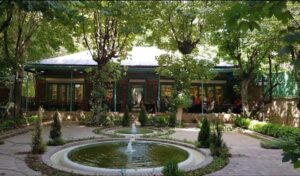
On Naser Khosrow Street, one of Tehran’s oldest thoroughfares, stands a building unlike anything around it: a Gothic-style facade with European-looking sculpture, built nearly a century ago as one of the city’s early commercial arcades. A Zoroastrian faravahar motif at the centre gives it a distinctly Iranian touch. It is a working commercial building rather than a museum, so admire it from the street.
5. Time Museum (Hossein Khodadad House)
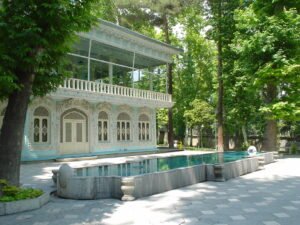
In Zafaraniyeh in north Tehran, this mansion was remodelled over 12 years by the industrialist Hossein Khodadad, who lived in it for only a year before the 1979 revolution. It has been a museum since around 2000 and is a listed national heritage building. Inside are hundreds of clocks and watches alongside sundials, hourglasses, water clocks and candle clocks; outside, admire the blue facade and stucco work, then wander the garden (Wikipedia).
6. Cinema Museum at Bagh-e Ferdows
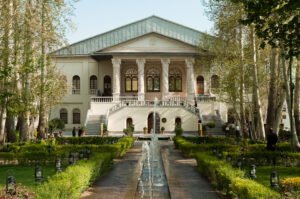
At the northern end of Valiasr Street, near Tajrish, a Qajar-era villa at the top of the Ferdows Garden now holds the Cinema Museum of Iran. The balcony’s floral plasterwork is worth a look in itself, and the exhibits trace Iranian film from its earliest days. There is a cafe in the garden for a tea or coffee afterwards. Combine it with a visit to Tajrish and its bazaar.
7. Green Palace at Sa’dabad
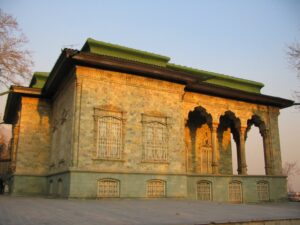
Many visitors rate the Green Palace as the loveliest building in the Sa’dabad complex. Built in the late Qajar period and rebuilt under Reza Shah, who lived there briefly before it became a guest house, it takes its name from the green marble cladding sourced from Zanjan and Khorasan. Inside are hand-woven carpets and mirror work. Sa’dabad holds several other palace museums, so allow at least half a day.
Tips for visiting
- Opening days and hours vary by museum and change on public holidays; check locally before setting out.
- Group the central sites (Golestan, Masoudieh, the Glass Museum and Naser Khosrow) into one day, and the northern ones (Time Museum, Cinema Museum, Sa’dabad) into another. The metro reaches both areas.
- Foreign visitors usually pay a higher ticket price than Iranians; see our Iran price trackers for current costs of everyday items.
For more historic houses, see our piece on magnificent mansions in Tehran, or browse our museums guides.