Updated November 2026 We have refreshed this guide with up-to-date tips on getting there, the hiking trail and when to visit.
Darband, the “gate of the mountain”, is Tehran’s favourite escape: a former village at the very top of the city where a stream tumbles down from the Alborz and a steep path is lined with teahouses, kebab grills and stalls selling dried fruit. Whether you want a proper hike, a lazy dinner beside the water or simply a break from the traffic, Darband is the easiest way to swap the city for the mountains in under an hour.

The name combines dar (door or gate) and band, an old word for mountain related to vand and fand. Darband once sat well outside Tehran, in the cooler foothills of Shemiran where Qajar-era families spent their summers. The city has long since swallowed it, but once you are walking up beside the river it still feels like a village.
In summer, Darband is several degrees cooler than central Tehran and the breeze off the mountains draws crowds every evening. In autumn the leaves turn, and in winter the upper paths are often under snow.
The Tajrish Bazaar is just down the hill, so it is easy to combine the two in one outing.
The trail and the teahouses
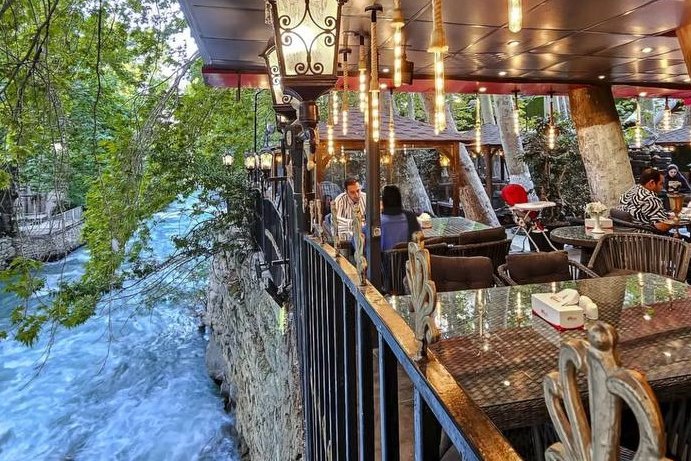
The walk starts from the small square at the top of Darband Street, often called Sarband. From here a stepped path climbs alongside the river, and the first stretch, a few hundred metres, is packed with cafes and restaurants. Many have raised wooden platforms (takht) covered in carpets where you sit cross-legged to eat dizi, kebabs or ash, drink tea and, in many places, smoke a water pipe. Stalls sell lavashak (fruit leather), pickled sour plums, roasted corn and fresh walnuts in season.

Beyond the restaurants the path becomes a genuine mountain trail. Keen hikers carry on to the Shirpala mountain hut and, for the very fit, all the way towards Tochal peak. Wear proper shoes, carry water and layers, and do not set off on the higher sections late in the day or in bad weather; conditions change fast, and every winter brings rescues.
When to go
- Early morning is best for a quiet walk. Fridays and holidays bring big crowds of hikers from dawn.
- Evenings are when the restaurants come alive, especially in summer. Expect a lively, noisy atmosphere and queues for the best riverside tables.
- Winter visits are lovely but icy; some teahouses close or shorten their hours.
The mountaineer statue

In the middle of the square stands the statue of a mountaineer, one of the best-known landmarks in north Tehran and a favourite photo spot. It has stood there for decades and has been registered as a national heritage monument (Tehran Times). Locals link it to the story of an Iranian army climber who led a rescue of foreign air crew stranded in the Alborz after a crash in the early 1960s.
Zahir-od-dowleh cemetery
Off the lower part of Darband Street lies the small Zahir-od-dowleh cemetery, resting place of many of Iran’s leading poets, musicians and artists, including the poet Forough Farrokhzad, the poets Iraj Mirza, Mohammad-Taqi Bahar and Rahi Mo’ayyeri, and the musicians Abolhasan Saba, Ruhollah Khaleqi and Darvish Khan. Access has been restricted at times, so do not be surprised if the gate is locked.
Getting to Darband
- Take metro Line 1 to Tajrish, the northern terminus.
- From Tajrish Square, take a shared taxi or a ride-hailing car up Darband Street to the square, or walk uphill for about half an hour.
- Parking near the top is very limited, especially on weekends, so leave the car at home.
Other mountain escapes are close by: the Tochal telecabin starts in nearby Velenjak and climbs to the ski slopes, covered in our guide to skiing and sledging near Tehran. For more on the area, see our guide to Darband and our piece on Tajrish.