Updated November 2026 We have corrected the construction date and directions and checked that the caravanserai is still trading as Tehran’s dried-fruit market.
Khanat Caravanserai is a restored Qajar-era inn in south Tehran, a short walk from Molavi and Shush, that now works as the city’s wholesale market for dried fruit and nuts. It is free to wander in, easy to combine with the Grand Bazaar area, and one of the few places in the capital where you can still see a traditional caravanserai doing roughly what it was built for: trade.

A short history
The caravanserai went up towards the end of Naser al-Din Shah’s long reign in the late 19th century. At the time it stood outside the city walls beside the road to the shrine of Shah Abdol-Azim in Rey, so it served pilgrims and merchants arriving from the south. As Tehran spread, the city swallowed it, and today it sits among the busy streets of District 12.
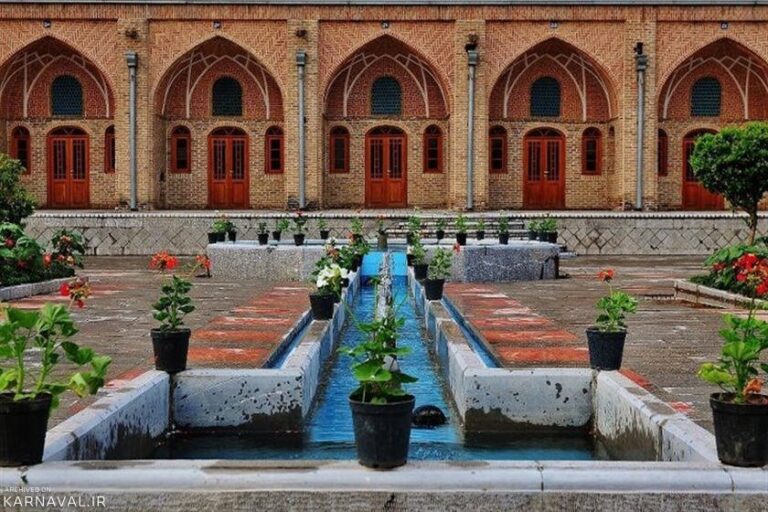
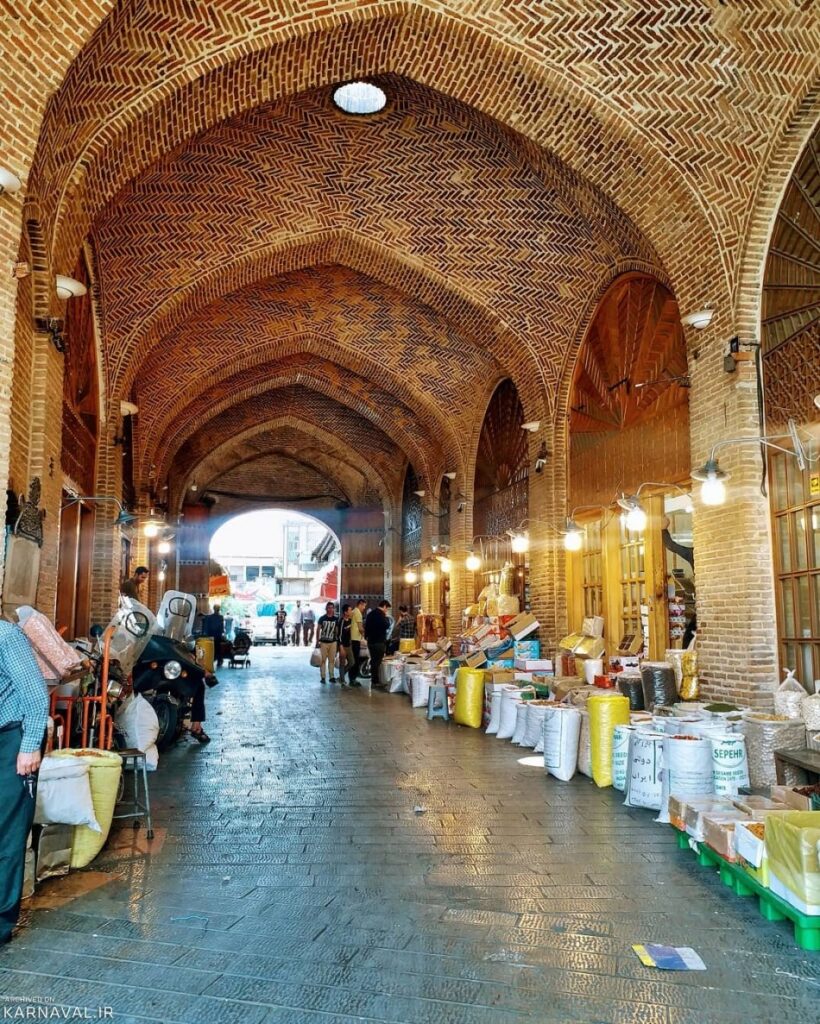
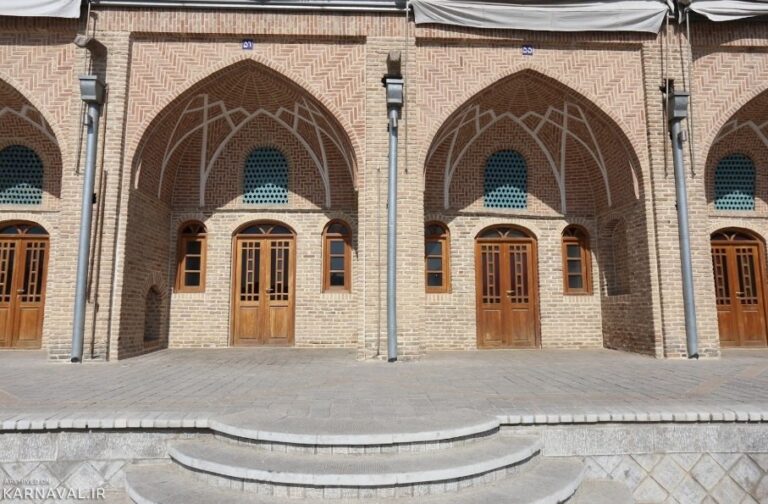
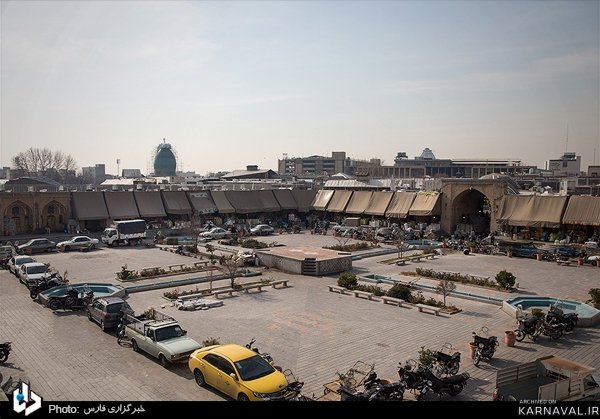
It was a big building for its day, covering roughly 10,000 square metres. The plan is the classic one: a domed passage leads from the street into a large rectangular courtyard ringed by small chambers where traders once slept and stored goods, with stables and storerooms behind. The name itself refers to these chambers. The only ornament is the brickwork, which is exactly why it is worth seeing: the arches and patterns are simple, well proportioned and very photogenic in the low afternoon light.

The building fell out of use after a fire in the late 1970s. It was added to Iran’s national heritage list in 2003, restored, and reopened in 2010, when it was first used to host Nowruz events. A traditional restaurant followed a few years later.

What to see and buy
The chambers around the courtyard are now occupied by dried-fruit and nut traders, so this is a good place to stock up on pistachios, almonds, walnuts, raisins, dried figs, apricots, mulberries and lavashak (fruit leather). Many of the shops are wholesalers, but most will happily sell by the kilo. Prices are generally better than in the smart northern shops; check our Iran price trackers for a feel of current costs before you haggle.

Look out for the tall wooden entrance doors studded with decorative nails, and the passage linking the complex to the old Amin al-Soltan bazaar next door. The restaurant serves traditional Iranian dishes and makes a convenient lunch stop if you are exploring the area.
Visiting tips
- Where: Saheb Jam Street, off Molavi Street, between Molavi junction and Shush Square in south Tehran.
- When: the market keeps working-day hours, from early morning into the evening. Individual shops set their own times and many close on Fridays and religious holidays, so go on a weekday morning for the liveliest atmosphere.
- Time needed: one to two hours, longer if you are shopping or eating.
- Cost: there is no ticket to walk around; you pay only for what you buy.
- Dress and manners: this is a working market, so dress modestly, keep to the side when porters come through with trolleys, and ask before photographing traders.
Getting there
By metro: the nearest station is Mohammadiyeh Square, an interchange on Line 1 and Line 7. From there it is a walk of around 15 to 20 minutes south along Molavi Street to Saheb Jam Street.
By BRT bus: BRT Line 2 (Azadi to Khavaran terminals) stops at Molavi junction, from where the caravanserai is a short walk.
By taxi: ask for Karavansara-ye Khanat on Saheb Jam Street. Traffic in this part of town is heavy, so the metro is usually quicker.
Visiting the Khan-at Caravanserai: at a glance
- Opening hours: Saturday to Wednesday: 09:00 to 19:00; Thursday to Friday: 09:00 to 15:00
- Time needed: 1 to 2 hours
- Address in Persian (show this to your driver): تهران، خیابان مولوی، جنوب چهارراه مولوی، خیابان صاحب جمع، میدان امین السلطان
- Open the Khan-at Caravanserai in Google Maps
Hours can change on public holidays and during Ramadan, so check before you set out.
The Khan-at Caravanserai in pictures
While you are in Molavi, it is worth seeking out the two oldest churches in downtown Tehran, and the wider Shush area is full of old workshops and markets.